Where the 8.8 magnitude earthquake ranks in history
A massive 8.8 magnitude earthquake struck Russia’s far eastern Kamchatka Peninsula on Tuesday, making it the sixth strongest ever recorded and the biggest since the 2011 quake that hit Japan.
A 9.5 magnitude earthquake struck in a central region of Chile in 1960.
In 1964, a 9.2 magnitude earthquake jolted the Alaska’s Prince William Sound, lasting for almost 5 minutes.
A 9.1 magnitude earthquake and resulting tsunami devastated Southeast and South Asia and East Africa in 2004, killing 230,000 people.
A magnitude 9.1 earthquake struck off the coast of northeastern Japan in 2011, triggering a towering tsunami that smashed into the Fukushima nuclear plant.
In 1952, a magnitude 9.0 quake caused significant damage but no reported deaths
A massive 8.8 magnitude earthquake hit central Chile in 2010, shaking the capital for a minute and half and setting off a tsunami.
In 1906, an 8.8 magnitude earthquake and resulting tsunami killed about 1,500 people.
In 1965, a magnitude 8.7 quake struck Alaska’s Rat Islands, causing an 11-meter (35-foot) -high tsunami.
At least 780 people were killed when a magnitude 8.6 earthquake struck in 1950.
In 2012, a powerful 8.6 magnitude earthquake struck off the west coast of northern Sumatra in Indonesia.
Rebecca Whittaker31 July 2025 23:00
Japanese woman evacuating amid tsunami warning dies after car falls off road
Bryony Gooch31 July 2025 22:00
How does this compare to the 2004 Boxing Day Tsunami?
It already appears the waves following the Russian earthquake are nowhere near as powerful as the 2004 Boxing Day tsunami.
In 2004, a 9.1 magnitude earthquake struck off the coast of Indonesia, causing waves that levelled remote villages, ports and tourist resorts along the Indian Ocean across Southeast and South Asia. Some 230,000 people died as waves up to 40m tall hit shorelines.
“What we’re seeing now so far is the maximum expected and the maximum observed is just higher than a bungalow, about 3 m,” explains Professor Ilan Kelman from UCL. “Most places are experiencing between 1m and 2m, which is sort of our height, how tall we are. They still kill.”
While an 8.8 magnitude earthquake appears on par with a 9.1 magnitude disaster, professor Kelman explains that there is a huge power disparity between the two.
“The scale is not a straight line, it’s actually a logarithm. The more you go up, the faster it gets more powerful,” he says. “So the difference between eight and nine is actually a tenfold difference in power.”
Bryony Gooch31 July 2025 21:00
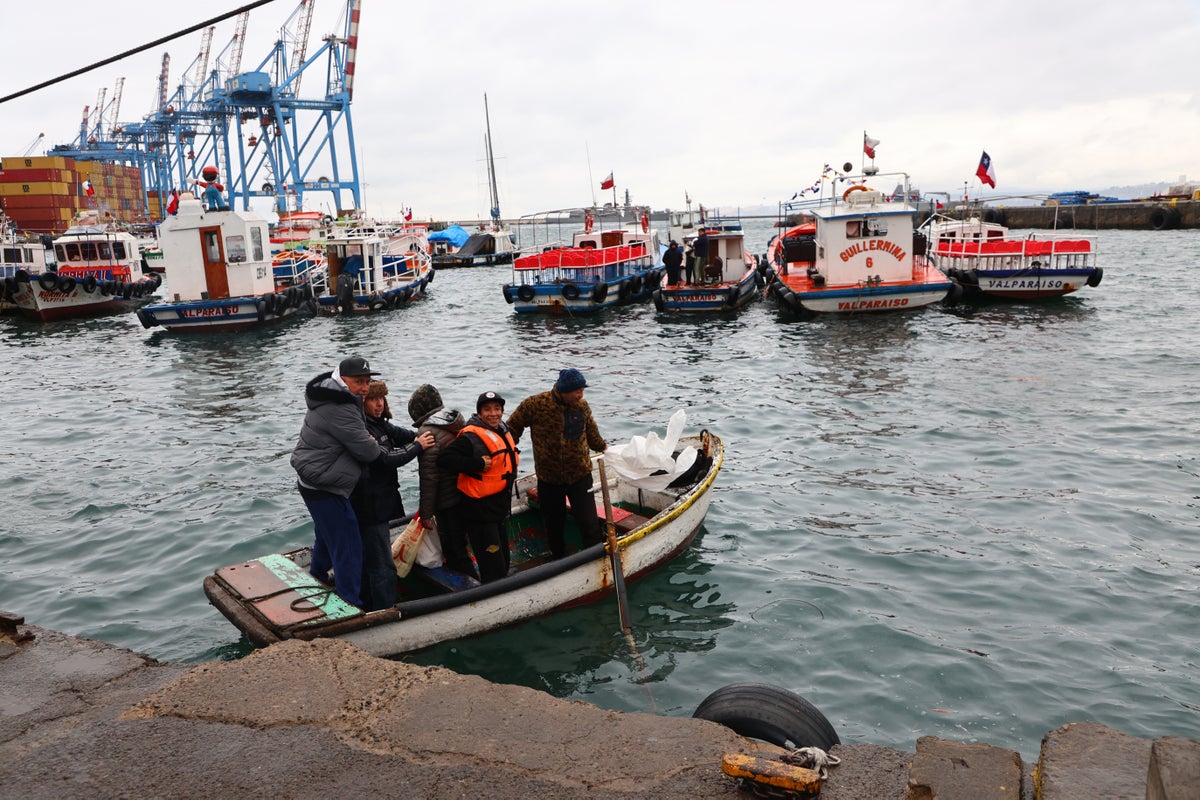
In pictures: Chilean harbours cope with tsunami


Bryony Gooch31 July 2025 19:00
Watch: Drone footage shows tsunami waves flooding Russian coastal town following earthquake
Bryony Gooch31 July 2025 18:00
The impact of the quake and tsunami on Kamchatka
The 8.8-magnitude quake, centered about 120 kilometres (75 miles from Petropavlovsk-Kamchatsky, struck at 11:24 a.m. local time (2324 GMT Tuesday, 7:24 p.m. EDT Tuesday) at a depth of about 21 kilometers (13 miles), according to the U.S. Geological Survey.
Multiple aftershocks as strong as 6.9 magnitude followed.
The earthquake appeared to be the strongest on record since the 9.1 magnitude earthquake off northeastern Japan in March 2011 that caused a massive tsunami.
Only a few stronger earthquakes have ever been measured anywhere.
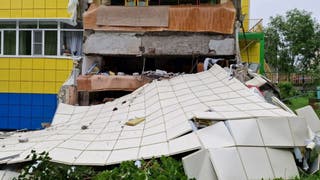
Authorities on Kamchatka and the Kurils said they were prepared for a major quake for a long time and acted quickly to protect the population.
Officials on Kamchatka said several people were injured, including a hospital patient injured while jumping out of a window. All were in satisfactory condition.
Municipal workers inspected hundreds of apartment buildings but didn’t find any signficant damage that would warrant evacuating residents.
Petropavlovsk-Kamchatsky was protected from big tsunami waves by its location on Avacha Bay.
In Severo-Kurilsk, the Kurils’ main city, tsunami waves as high as 6 meters (over 3 feet) flooded the fishing port and swept fishing boats out to sea
Bryony Gooch31 July 2025 16:00
Japan lifts tsunami advisory
Japan’s weather office has lifted a tsunami advisory imposed a day earlier after a major earthquake in pacific Russia.
The Japan Meteorological Agency (JMA) issued a statement lifting the advisory on Thursday afternoon (07.45am local time).
“There is currently no coastal area for which tsunami warnings or advisories are in force,” the Japanese agency announced.
Almost two million people had been ordered to higher ground in Japan before the warnings were downgraded to an advisory for large stretches of its Pacific coast.
One woman died and a further 10 were injured as they rushed for shelter.
Bryony Gooch31 July 2025 15:30