A hundred-billion-euro gamble is teetering on the edge, with
Paris and Berlin locked in a tug-of-war for control.
The Future Combat Air System (FCAS), Europe’s much-touted
sixth-generation fighter jet and integrated air-combat network, was
supposed to be the crown jewel of the continent’s push for
“strategic autonomy.” It was billed as the answer to America’s
F-35, China’s stealth programs, and Japan’s partnership with
Britain and Italy. Instead, the project has become a symbol of
Europe’s inability to keep its defense ambitions from being
hijacked by national rivalries.
The rift is hardly new. Paris and Berlin have long sparred over
how far Europe should go in relying on its own defense industry.
The latest flashpoint came when Germany opted to buy weapons for
Ukraine from U.S. firms—a move France blasted as a betrayal of the
“Buy European” principle. That dispute pales in comparison to the
bitter fight now raging over FCAS itself.
On paper, Dassault Aviation of France, Airbus Defence and Space
of Germany, and Spain’s Indra are supposed to be equal partners. In
practice, Paris has called most of the shots. Now France is
pressing for a larger stake in the program—one that would give it
veto power over exports. In Berlin, that looks less like
cooperation and more like an attempt to lock in French dominance
over Europe’s most important defense project.
The politics are impossible to ignore. Germany has inched closer
to Washington in recent years, stoking French doubts about its
reliability. If Boeing pushes its own sixth-generation platform
onto the market, will Berlin hold the line for FCAS—or fold under
American pressure? The original mission—leapfrogging the U.S. in
air-combat technology—already feels diluted.
The numbers are staggering: more than €100 billion by 2040. FCAS
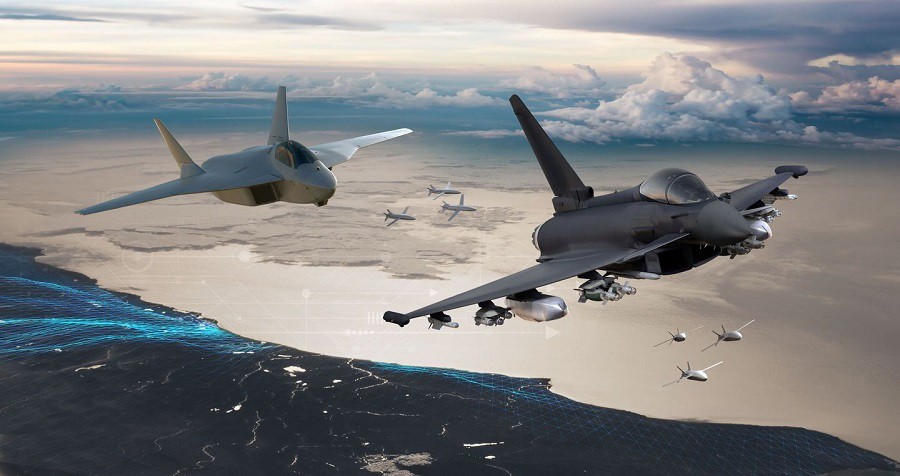
isn’t just a plane. It’s a whole war-fighting ecosystem—manned jets
working in tandem with drones, cloud-based battle management,
artificial intelligence coordinating every move. The vision is
bold: Europe not just catching up, but setting the pace in military
aviation.
But the project’s history shows how fragile that vision is.
Britain, once part of the conversation, walked away to team up with
Italy and Japan on the rival Global Combat Air Programme (GCAP)—a
venture that, by most accounts, is moving faster. Instead of unity,
Europe may end up with competing flagship projects, each jealously
guarded by its own national champions.
The fate of FCAS is bigger than one aircraft. It’s a stress test
for Europe’s entire defense integration project. If Paris and
Berlin can’t hold this together, the continent risks losing not
just billions, but also the credibility of its claim to genuine
strategic independence.
The cracks go back years. As early as 2021, French officials
worried their leadership role would be diluted if Germany and Spain
commanded most of the orders. That same year, a classified German
defense ministry report bluntly warned that France’s “dominant
position” risked turning FCAS into “a Rafale 2.0 financed by German
and Spanish budgets.” Those words summed up a deeper mistrust that
has only hardened with time.
The promise of FCAS was to showcase Europe’s ability to stand on
its own in a dangerous world. Instead, it has become a mirror
reflecting the continent’s divisions—and a warning of just how
costly they could be.
What was meant to be a showcase of Europe’s strategic autonomy
has devolved into a bare-knuckle fight for control. France,
officially sharing the Future Combat Air System (FCAS) with Germany
and Spain as an equal partner, is maneuvering for dominance. Berlin
is growing increasingly resentful, seeing Paris’s ambitions as a
bid to bend the entire venture to the interests of Dassault
Aviation. And France has a powerful tool at its disposal: the fine
print of the 2019 Aachen Treaty, which allows Paris to block arms
exports if they threaten its national interests.
Germany, meanwhile, looks less and less like an independent
player. Its tilt toward Washington—underscored by Berlin’s decision
to buy American weapons for Ukraine—has only deepened French
suspicion. The obvious question is: what’s to stop Germany from
eventually throwing its weight behind Boeing’s sixth-generation
fighter project? Could FCAS end up hostage to the shifting winds of
American politics?
On paper, the program is breathtaking: more than €100 billion in
investment, a multirole fighter at the center, surrounded by
drones, cloud-based systems, and artificial intelligence to
choreograph aerial combat. But the bigger the vision, the sharper
the clash of interests. Dassault, Airbus Defence and Space, and
Spain’s Indra are still technically in the same boat, but each is
rowing toward its own priorities.
Europe has been here before. Joint defense dreams have often
collapsed under the weight of national egos. Britain once sat at
the FCAS table, too—before peeling off to launch the Global Combat
Air Programme (GCAP) with Italy and Japan, a project that experts
now say is pulling ahead of FCAS. Which means the current squabble
between Paris and Berlin isn’t just Brussels-style bureaucracy—it’s
a barometer of how fragile Europe’s very notion of military
autonomy really is.
The roots of today’s crisis stretch back to 2021, when the first
public rifts opened. Paris feared that Germany and Spain combined
could control two-thirds of the contracts, effectively sidelining
France as project leader. A classified German defense ministry
report that year was blunt: France’s “dominant position,” it
warned, threatened to turn FCAS into “a Rafale-Plus funded by
German and Spanish budgets” rather than a truly joint, next-gen
system. The mistrust baked into those words has only deepened
since.
Right now, FCAS is in the phase of locking down core
technologies and preparing for a demonstrator. Roughly €3.2 billion
has been earmarked for this stage, which is supposed to wrap by
summer 2026. If the timeline holds, a working prototype should be
ready by 2029. But even now the question hangs in the air: can the
partners actually make it that far together?
In France, hints are growing louder that the country may go it
alone if the three-way arrangement collapses. Lawmakers have
started asking outright: “Can we do this on our own?” Dassault CEO
Eric Trappier told parliament this spring that equal work-share
rules are choking progress. FCAS, he argued, is built around tight
integration of fighter and drones—something that requires
centralized leadership. “If no one is clearly in charge,
coordination is simply impossible,” he warned.
French defense minister Sébastien Lecornu was just as blunt in
the National Assembly: “We need an honest conversation about
leadership. Building a fighter with three countries is incredibly
difficult.” In Berlin, those remarks landed like a power grab.
Germany’s aerospace industry association, BDLI, accused France of
dressing up naked ambition as cooperation.
The clash has spilled far beyond boardrooms and trade groups.
FCAS is now a political symbol, debated at the highest levels of
government. On July 24, at Villa Borsig on Lake Tegel, Chancellor
Friedrich Merz and President Emmanuel Macron agreed to task their
defense ministers with drafting a “realistic outlook” for the
project by the end of August. The plan is slated for presentation
at a joint Franco-German cabinet meeting in Toulon on August 28–29,
with final decisions expected before year’s end.
German defense minister Boris Pistorius tried to calm the waters
during a meeting with Lecornu in Osnabrück. “I am convinced that
European defense can only be strengthened through close
Franco-German cooperation,” he insisted. But in practice, Paris and
Berlin are drifting ever further apart in their very definition of
what a “joint project” actually means.
Whether France and Germany can ultimately hammer out a deal on
FCAS remains an open question. And it’s not just about technical
specs—it’s about fundamentally different political and economic
strategies. The arrival of Chancellor Friedrich Merz has only
underscored the split. For Emmanuel Macron, FCAS is a pillar of
“strategic autonomy,” a symbol of Europe cutting the cord from
Washington. For Berlin, the slogan of “gradual independence from
the U.S.” is more diplomatic varnish than actual policy. In
practice, Germany is drawing ever closer to America—from trade
arrangements with the EU to buying U.S.-made weapons for
Ukraine.
France hasn’t exactly cooled tempers either. Paris is insisting
the new jet be built in a carrier-capable version for its own navy.
For Germany, which doesn’t operate carriers, that’s a non-issue.
Even more sensitive is the nuclear question: FCAS’s ability to
carry France’s nuclear payload. It’s almost never discussed in
public, but it looms as perhaps the single biggest obstacle to
compromise.
It’s worth recalling how FCAS was born. The idea first took
shape in Donald Trump’s early years, when European governments were
desperate to shore up independence from Washington—not only in
politics, but in defense technology and supply chains. But since
then, the landscape has shifted. Germany’s defense industry is now
more deeply embedded in the American ecosystem than ever
before.
The F-35 purchase was a case in point. Berlin ordered the
Lockheed Martin fighter but insisted on some local production.
Rheinmetall, based in Düsseldorf, secured a major share of that
work. Yet more than a third of Rheinmetall’s stock is in North
American hands. The company is expanding its U.S. partnerships,
further entrenching reliance on American capital and
technology.
Airbus, the cornerstone of Germany’s role in FCAS, is on a
similar track. Its partnerships with American giants—from Northrop
Grumman to Kratos—run deep. Just this July, Airbus and Kratos
launched a joint drone program. And in Arlington, Virginia, Airbus
U.S. Space & Defense has been operating for nearly half a century,
embedded in projects with the Pentagon, DARPA, NASA, and other
agencies.
Dassault Aviation, by contrast, is far less entangled with the
U.S. defense complex. Two-thirds owned by the Dassault family
through Groupe Industriel Marcel Dassault, the company’s dealings
with Lockheed Martin are minor—flight simulators and training gear.
Unlike Airbus, it has no U.S. subsidiaries and no stake in
America’s defense architecture. That’s precisely why Paris insists
on taking the lead: France sees FCAS as a last chance to keep
control over critical technologies and prevent the program from
being diluted into yet another extension of American interests.
Against this backdrop, even if Macron and Merz make good on
their promise to present a “realistic outlook” for FCAS by the end
of 2025, the core contradictions won’t go away. FCAS isn’t just an
airplane—it’s a mirror reflecting the split between France and
Germany’s strategic worldviews.
At the heart of the dispute is the question of whether to share
key technologies or keep them under lock and key. France made its
position clear early on: it will not hand over its crown jewels
wholesale. That was already the spark of a bruising 2021 clash
between Dassault and Airbus. Berlin demanded access to critical
systems; Paris insisted some stay sealed in a “black box.” For
France, this isn’t just policy—it’s history. Back in the 1980s,
Dassault walked away from the Eurofighter project, choosing instead
to build the Rafale on its own.
That tension was laid bare in recent comments by Jean-Brice
Dumont, head of Airbus Defense and Space. Switching from one
partner to another, he admitted, is fraught: today you’re guarding
intellectual property, tomorrow you’re expected to hand it over in
full. Airbus is used to a culture of shared technology. Dassault is
not. This clash of philosophies—Airbus’s openness versus Dassault’s
tight grip—is the central drama of FCAS.
It’s hard to ignore the fact that Dassault holds the stronger
hand. The Rafale has become a global best-seller—from India and
Indonesia to the UAE, Egypt, and Serbia—its export demand steady
and robust. That success is more than a commercial coup; it’s a
political tool in France’s arsenal. Against that backdrop, it’s
hardly surprising that many in Paris are asking: why risk diluting
control in a joint venture when Dassault could simply chart its own
course and keep all the export spoils for itself?
The arrival of new players has only made things messier. In
2024, Belgium was granted observer status and access to FCAS
program data. Officially, this was explained as a response to
procurement hiccups with Lockheed Martin’s F-35. Unofficially, it
was a gambit to keep Brussels tethered to Europe. Dassault
bristled. CEO Eric Trappier went public, saying Belgium’s
simultaneous buy-in to F-35 made its role in FCAS “a farce.”
Belgian defense minister Theo Francken fired back, insisting that
as a NATO and EU member, his country didn’t need lectures from
“arrogant industrialists.”
That sharp exchange fuels an uncomfortable suspicion: is
Dassault itself maneuvering to derail FCAS? From a purely economic
standpoint, the logic is clear. The company is thriving without the
program, and if it pivots to building its own sixth-generation jet,
it would secure near-monopoly control of exports—without
Brussels-style bureaucracy and endless negotiations tying its
hands.
This makes the fight over data-sharing more than a technical
squabble. It’s a litmus test: either Europe moves toward a shared
defense identity built on mutual trust, or it backslides into
national projects where each country prioritizes its own interests
and profits. With its powerhouse export portfolio, Dassault could
well be the catalyst for such a pivot.
In the end, money is the decisive factor. Even if France doesn’t
bolt from the consortium, the financial burden will dictate the
program’s trajectory. Technologically, Paris could pull it off
alone. Economically, it’s a backbreaker. The official figure of
roughly €100 billion through development is already seen less as a
serious estimate and more as a political compromise.
Greenpeace puts the real price tag into sobering perspective.
Counting the full life cycle, the bill won’t be in tens of billions
but in trillions. Analysts warn that operational costs—usually
understated in early projections—make up the lion’s share. By 2070,
the total outlay could hit between €1.1 and €2 trillion. For
defense contractors, that spells windfall profits. For European
taxpayers, crushing debt.
Spain has already made a symbolic move: rejecting the F-35 and
committing instead to either the Eurofighter or FCAS. That decision
gave the project a political boost but did nothing to answer the
toughest question: who will shoulder the bulk of the costs?
Berlin has tried to tie FCAS’s fate to another flagship joint
venture with France: the MGCS tank program, in which Rheinmetall
plays the lead role. German defense minister Boris Pistorius
declared on July 24 that both FCAS and MGCS should symbolize
Franco-German partnership rather than fall prey to “national
egoism.” He stressed Berlin’s “full and unanimous support” for both
initiatives.
But words are cheap. In practice, both FCAS and MGCS are
wobbling on the brink. If France this time—unlike in the
1980s—chooses to stay in the joint program, the decisive factor
will be Germany’s willingness to fund it without caveats. Berlin is
poised to massively ramp up defense spending in the coming years.
Whether it commits those resources will determine if FCAS becomes
the emblem of European technological independence—or just another
grand ambition that never made it off the drawing board.