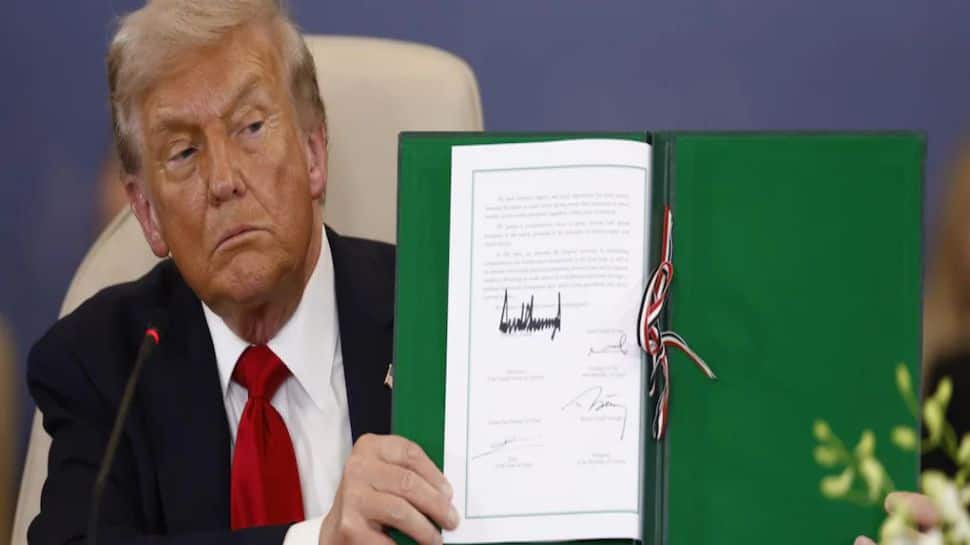
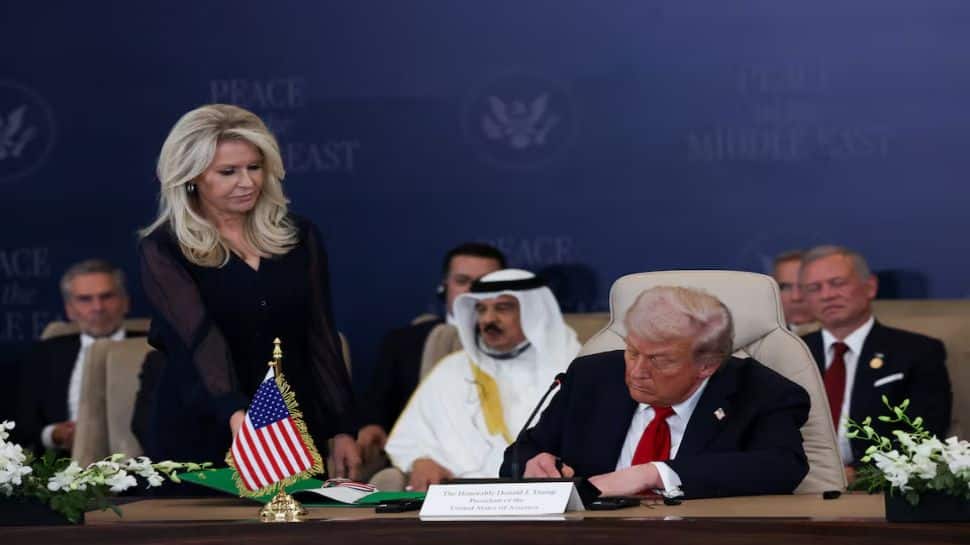
Cairo (Egypt): In a hall filled with flags, cameras and a mix of world leaders from East and West, US President Donald Trump held up a document in Sharm el-Sheikh, Egypt, on Monday and called it “a very important signing”. It was, he said, the Gaza ceasefire deal. But as applause echoed across the room, one question immediately arose: what does the deal actually say?
A close look at a photograph from the event offered the first real glimpse. The top half of the page spoke about “tolerance, dignity and equal opportunity for every person” and a vision of a region “where all can pursue their aspirations in peace, security and economic prosperity, regardless of race, faith or ethnicity”.
“We seek tolerance, dignity and equal opportunity for every person ensuring this region is a place where all can pursue their aspirations in peace, security and economic prosperity, regardless of race, faith or ethnicity,” read the first paragraph on the last page.
Add Zee News as a Preferred Source

The bottom half contained signature of leaders from the United States, Egypt, Qatar and Turkey – the key mediators who had pushed the agreement through.
Trump signed the Gaza ceasefire deal along with Egypt’s President Abdel Fattah el-Sisi, Qatar’s Emir Tamim bin Hamad Al-Thani and Turkey’s President Recep Tayyip Erdoğan.
Trump described the signing as a “very important” moment and thanked his staff and regional leaders for their “amazing array of talent” that helped secure what he called the “toughest deal” to accomplish.
The White House later released the signed agreement, titling it the “Trump Peace Agreement”. The declaration celebrates what it calls a “truly historic commitment” by all parties to implement the agreement.
The document emphasises ending over two years of conflict and presents a vision of the region defined by “hope, security and a shared vision for peace and prosperity”, though it is light on specifics.
“We understand that lasting peace will be one in which both Palestinians and Israelis can prosper with their fundamental human rights protected, their security guaranteed and their dignity upheld,” the agreement reads.
It reaffirms a commitment to resolving future disputes through diplomacy rather than prolonged conflict. “This is a new chapter for the region,” it further reads.
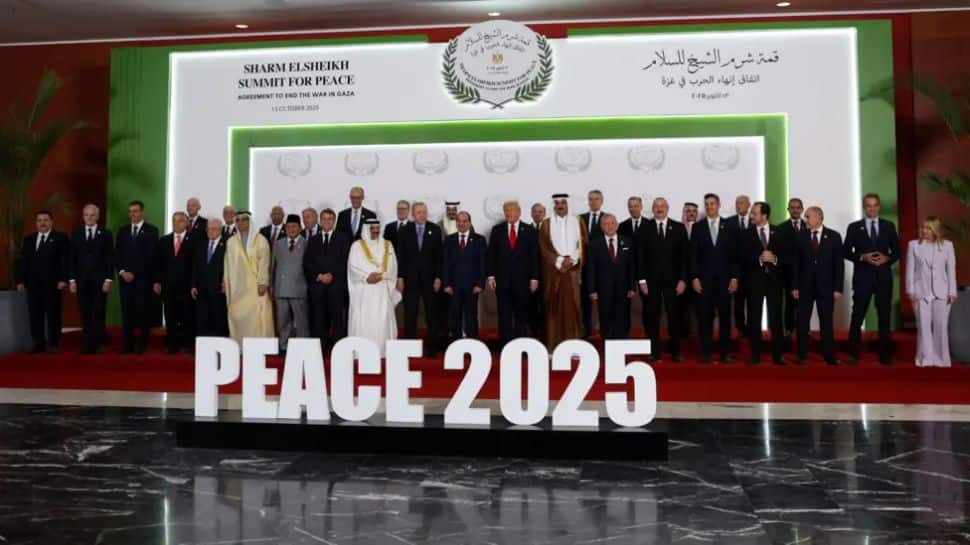
More than two dozen nations attended the summit, including Armenia, Azerbaijan, Bahrain, Canada, Cyprus, Egypt, the European Union, France, Germany, Greece, Hungary, India, Indonesia, Iraq, Italy, Japan, Jordan, Kuwait, the Netherlands, Norway, Oman, Pakistan, the Palestinian Authority, Paraguay, Qatar, Saudi Arabia, Spain, Turkey, the United Arab Emirates and the United Kingdom.
Representatives of the Arab League, UN Secretary General António Guterres, FIFA President Gianni Infantino and former British PM Tony Blair were also present.
Egyptian President Abdel Fattah el-Sisi called on Israelis to treat the ceasefire as a “new beginning for a life governed by justice and peaceful coexistence” and urged a better future for the next generation.
“This is the first time the Middle East crisis has brought people together, as opposed to driving them apart,” Trump said, emphasizing cooperation and goodwill. “The greatest deals just sort of happen. And that’s what happened right here. Maybe this is going to be the greatest deal of them all.”
Trump has since departed Egypt for Washington, leaving world leaders with a ceasefire agreement that could define the next chapter in Middle East diplomacy.
Part ceremony and part spectacle, the signing came after weeks of intense diplomacy. Trump appeared buoyant, calling the day “historic”. “I thought this was probably going to be the toughest, and maybe in many ways it was. But we had a lot of big talent. We had an amazing array of talent,” he said.
Trump’s remarks stretched far beyond the paper in his hand. “This is the day people across the region and around the world have been working, striving, hoping and praying for. They have done things over the last month that I think were really unthinkable,” he said.
He spoke of rebuilding Gaza. “For the people of Gaza, the focus now must be on restoring the basics of a good life. We are going to have a lot of money coming into Gaza and a lot of rebuilding and building,” he said.
He added that Gaza’s reconstruction “requires that it be demilitarised” and “a new honest civilian police force must be allowed to create safe conditions for the people”.
Another piece of the plan, Trump revealed, was a new “Board of Peace”, an international transitional body that would oversee the temporary government in Gaza.
“We are going to put some of you on the Board of Peace. Everybody wants to be on the Board of Peace,” he said.
More than two dozen countries were represented at the summit, according to the White House. Among them were Egypt, Qatar, France, Germany, India, Saudi Arabia, the United Kingdom and the United Nations. Held at the Red Sea resort of Sharm el-Sheikh, the gathering was described as one of the largest Middle East summits in recent years.
Egyptian President Abdel Fattah el-Sisi addressed the room soon after the signing. “Let us make this historic moment a new beginning for a life governed by justice and peaceful coexistence,” Sisi said.
Turning to Trump, he added, “Mr. President, let the Gaza war be the last war in the Middle East.”
Sisi praised the US role in brokering peace and said that only “exceptional figures capable of courageous initiatives” could bring such an agreement to life.
Former US President Bill Clinton, who had once tried and failed to secure peace in the region, also weighed in. “President Trump and his administration, Qatar and other regional actors deserve great credit for keeping everyone engaged until the agreement was reached,” Clinton wrote in a post on X.
He urged both Israel and Hamas “to turn this fragile moment into lasting peace that provides for the dignity and security of both Palestinians and Israelis”.
As the summit ended, Trump flew back to Washington, calling the deal “something very unique and very special”. “The greatest deals just sort of happen. And maybe this is going to be the greatest deal of them all,” he said.
For now, though, the document remains a symbol, held high before cameras. Its promises of tolerance, dignity and prosperity are written in bold lines, but the real test will unfold far from the signing table, in Gaza’s broken streets and in the uneasy quiet of the days ahead.